
The Unwinding of JP Morgan's 6.2 billion ounce short.
An internal risk document shows JPMorgan’s silver book facing hundreds of billions in unrealized losses, regulatory ultimatums, and a structural short position 8X Global AG Mining.

Leaked JPMorgan Memo Exposes a 6.2 Billion-Ounce Silver Short on the Edge of Collapse
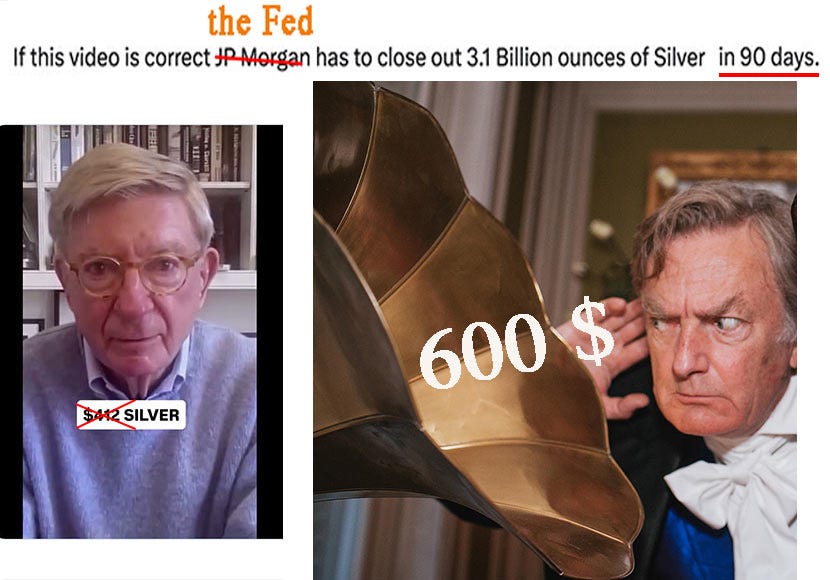
AI style video of George Will looking character
a “leaked memo” and he explains the memo in the video and how silver will soon be $412 per ounce.
At 4:47 a.m. on January 6, 2026, a confidential risk management memo landed in the inboxes of seventeen senior JPMorgan executives under a stark subject line: “Urgent: Silver Position Liquidation Protocol Initiation.” Behind the dense legal language and risk formulas, one instruction captured the entire direction of the bank’s next six months: initiate covering operations.
For more than fifteen years, JPMorgan has sat at the center of silver’s price structure, not as a neutral intermediary, but as the dominant dealer, vault operator, and derivatives house on the COMEX and over-the-counter markets. This is the institution that paid a record $920 million to U.S. regulators in 2020 for years of spoofing and manipulation in precious metals and Treasury futures, a penalty that confirmed what many in the silver community had alleged for more than a decade. Yet after the fine, the basic structure of the market did not change: JPMorgan remained the house.
The leaked memo suggests that era is ending under duress. According to the document, JPMorgan’s net short exposure across silver futures, swaps, and related derivatives stands at roughly 6.22 billion ounces—an amount that dwarfs annual global mine output, which has hovered around 800–820 million ounces in recent years. The bank accumulated this position between 2010 and 2024 at an average entry price near 18.47 dollars per ounce, but with silver now trading at many multiples of that level, internal estimates put the unrealized loss at approximately 377 billion dollars and label it a “critical threat to firm solvency.”
This is not the language of routine risk management. It is the language of triage.
“The memo labels JPMorgan’s silver exposure a ‘critical threat to firm solvency’ and orders the bank to initiate covering operations on a 6.2 billion-ounce short.”
Three Crises, One Conclusion: Cover or Die
The memo identifies three converging crises forcing an immediate pivot: regulatory pressure, delivery shortfalls, and an internal risk model that turned on its creators.
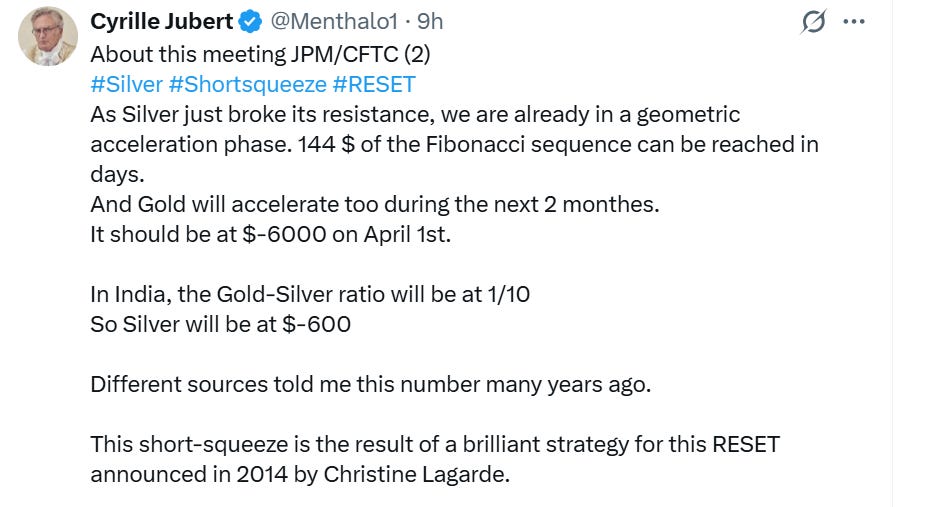
First, the regulatory threat. On December 30, 2025, the Commodity Futures Trading Commission (CFTC) convened an emergency closed-door session with JPMorgan’s senior management to address the scale of the bank’s concentrated silver short. The CFTC warned that JPMorgan’s position had grown so large it threatened orderly market functioning and issued a directive: cut the silver short by at least 50 percent within 90 days or face forced liquidation under emergency authority.
A 50 percent cut translates into roughly 3.1 billion ounces of buying by early April in a market that, according to the Silver Institute, produced about 820 million ounces in 2024 and is projected near 830–835 million ounces in 2025. That is the equivalent of compressing nearly four years of global mine supply into a single quarter, an order of magnitude for which existing liquidity is simply not designed.
Second, the vault and delivery crisis. An internal audit completed on December 31, 2025, found that JPMorgan’s vaults held roughly 380 million ounces of silver eligible for delivery, while its outstanding obligations on maturing futures and OTC contracts totaled about 1.24 billion ounces over the next six months. The resulting shortfall—around 860 million ounces—exposes the bank to potential non-delivery claims that the memo estimates could exceed 300 billion dollars once replacement costs, legal damages, and punitive penalties are factored in.
Third, the machine revolt. Since 2015, a proprietary risk engine known internally as “Silver VAR 9” has guided position sizing in the bank’s precious metals book, smoothing volatility and sanctioning the continuation of the short strategy as “manageable.” In late December 2025, the model crossed a critical threshold, projecting an 87 percent probability of a catastrophic loss event within six months if the silver short was not dramatically reduced. In practical terms, the model’s stress scenarios showed silver prices pushing beyond 400 dollars per ounce if covering did not begin immediately, rendering the existing exposure incompatible with solvency.
Taken together, the three crises leave the bank with only two paths: default or vertical repricing.
The Physics of an Impossible Cover
Silver is not a digital asset that can be conjured on demand, nor a central-bank-managed currency; it is a mined, finite industrial and monetary metal. The Silver Institute’s data show global mine production around 820 million ounces per year, with a five-year cumulative supply deficit approaching 800 million ounces by 2025 as industrial demand outpaces new supply. Most of this metal never reaches free-floating exchange inventories; it moves directly into sectors like solar, electronics, and medical applications under long-term contracts.
In that context, a 6.2 billion-ounce short is structurally impossible to cover quietly. At best, only a few hundred million ounces per year are realistically available to absorb speculative buying and bank covering without blowing out price. The memo’s own modeling reportedly places the likely “controlled explosion” level around 412 dollars per ounce—the price at which JPMorgan’s risk team believes new supply and selling might finally appear in sufficient size to prevent a broader systemic break.
The execution plan reads like a war schedule. January: stealth accumulation via off-exchange deals with miners, sovereign entities, and large holders to avoid obvious footprints on COMEX. February: controlled futures buying and standing for delivery, just enough to begin tightening spreads without triggering panic. March: accelerated covering across futures and OTC contracts, with expected volatility spikes and widening lease rates. April marks the CFTC’s 90-day deadline, a period the memo describes as “maximum intensity” as the bank must demonstrate a 50 percent reduction in its short exposure. May and June are allocated to forward contracting at elevated prices and stabilizing around a new, higher equilibrium in which the former suppressor has become the dominant buyer.
The critical psychological piece is timing: the early phases are designed to look normal.
“In a market already running multi-year supply deficits, asking it to absorb billions of ounces of short covering is not price discovery—it is detonation.”
From Suppressor to Buyer
JPMorgan is not the only large short in silver, but it is the largest and the most structurally embedded in price discovery through COMEX. If this memo is genuine and the bank is now executing a forced pivot from structural short to desperate buyer, other banks will read that signal instantly.
No dealer wants to be the last short in a market where physical inventories are tight, exchange stocks are falling, and cumulative deficits already approach a billion ounces. The likely result is not one institution covering, but a stampede of counterparties racing each other to exit synthetic exposure and secure metal in a market that cannot meet the demand at anything resembling prior prices.
History shows what exchanges do when confronted with disorderly moves in thin physical markets: they halt trading, raise margins, change rules midstream, and, in extremis, cash settle rather than force delivery. That is why the real battleground in silver has never been the quoted spot price on a screen, but the availability of deliverable ounces when stress hits.
If JPMorgan—the institution long accused of sitting on silver’s throat—now scrambles to cover 6.2 billion ounces under regulatory and mathematical duress, the question for the broader market is not whether the price can go higher. It is how fast it can move before the system is forced to admit that paper and physical were never the same battlefield
end of segment
end of segment
our opinions are not our sponsors opinions
the editorial department is separate from the promotions department
not financial advice