
$200 Silver Incoming: Export Bans, Empty Vaults, and the Worldwide Return of Silver as Legal Tender
Nations race for bullion as silver transforms from industrial staple to monetary lifeline—export bans, collapsing inventories, and state legalization ignite a worldwide rush for real metal

This Silver 50 year chart is beyond words
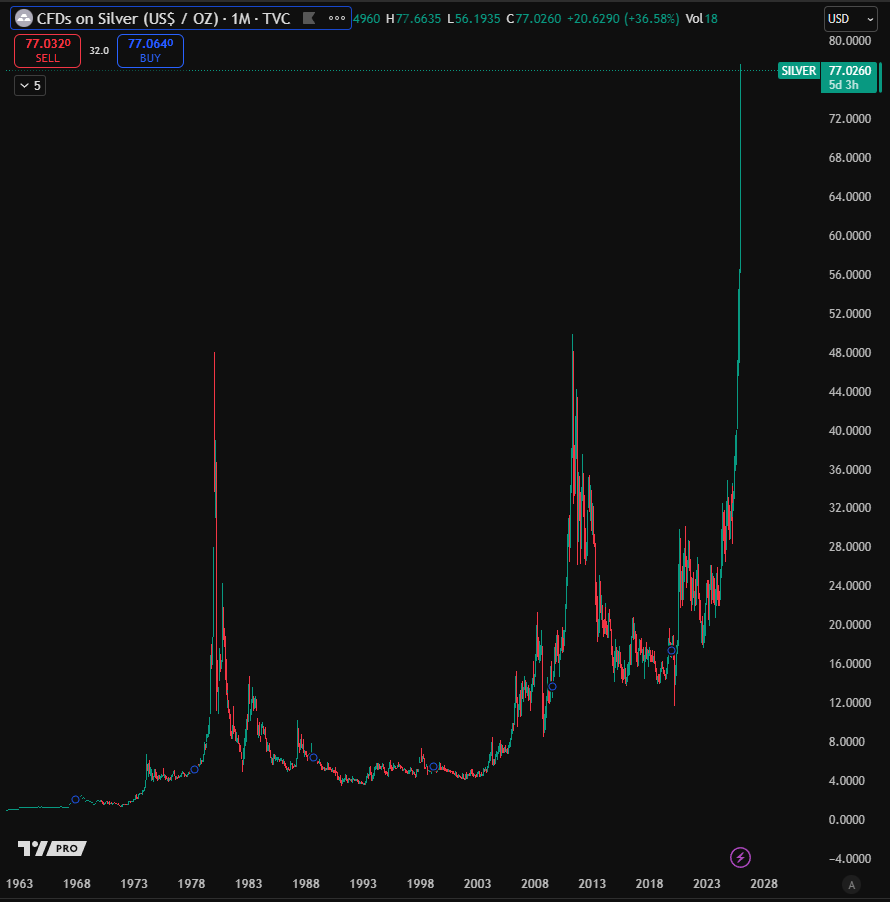
Silver is no longer inching higher—it is detonating in real time, shredding every complacent model Wall Street ever built about this “boring” metal. A once‑in‑a‑generation supply shock has collided with record industrial demand, and the result is a vertical, panic‑driven repricing of the world’s most critical metal.
China lights the fuse
Starting January 1, 2026, Beijing will seize direct control over the arteries of global silver trade. Every ounce leaving China will require a state-issued export license, granted only to large, politically favored enterprises with massive production and deep credit lines, mirroring the chokehold tactics once used on rare earths. For hundreds of smaller refiners and mid-tier producers, the export window does not just narrow—it slams shut.
China is not a niche supplier on the fringes; it is the central pillar, controlling the bulk of globally tradable silver just as a new wave of industrial demand detonates across solar, EVs, and high‑tech manufacturing. When that pillar locks down exports, the rest of the world does not “adjust”—it scrambles, outbids, and cannibalizes its own dwindling inventories.
A deficit that will not die
This export clampdown strikes a market already bleeding from five consecutive years of structural deficit, where annual demand has consistently outstripped mine and recycling supply by tens to hundreds of millions of ounces. Analysts now concede the 2025 shortfall alone runs into a nine‑figure ounce gap, with no credible plan to close it as base‑metal‑linked mine output stagnates and ore grades continue to decline.
Silver is not like a tech stock that can “scale” in the cloud; new primary mines require a decade or more, billions in capital, and permitting environments increasingly hostile to large-scale extraction. Recycling adds a modest trickle, not a flood, leaving a structural hole that gets deeper with every new solar factory, data center, and EV assembly line that comes online.
Vaults are being drained
The proof of this crisis is no longer theoretical—it is visible in the emptied vaults and collapsing inventories from New York to London to Shanghai. COMEX registered stocks have plunged more than 70% from their 2020 peak, London inventories sit at historic lows, and Chinese exchange warehouses have been drawn down to levels that scream outright shortage. At current burn rates, key hubs are operating on weeks—not years—of readily deliverable metal, a razor‑thin buffer in a market this systemically important.
That is why physical premiums are going berserk, with Asian cash markets already paying breathtaking markups over futures benchmarks as desperate buyers bid for actual metal, not promises. This is what happens when the world discovers that “inventory” was just a comforting word for metal that no longer exists in size.
Paper illusions, real consequences
Hovering over this powder keg is a paper market grotesquely outsized relative to the underlying metal, with hundreds of synthetic claims stacked on top of each ounce that still sits in vaults. For years, this leverage machine kept prices subdued, lulling institutions into the fantasy that silver was abundant and always available on demand. Now, as physical tightness morphs into outright scarcity, even a small wave of delivery requests has the potential to overwhelm the system and force a historic repricing.
Industry cannot walk away
Unlike gold, silver is not merely a monetary refuge—it is the bloodstream of modern technology, with industrial usage now comprising over half of total global demand. Solar manufacturers, EV builders, electronics giants, and medical device producers cannot “opt out” of silver without shutting down entire product lines, because no scalable replacement exists for many of its unique conductive and antimicrobial properties.
So as banks, institutions, and sovereigns wake up to export controls, collapsing inventories, and leveraged paper towers, they are not chasing a narrative—they are chasing survival in a market where the squeeze is no longer hypothetical. Silver is not just rallying; it is revaluing, violently and publicly, as the world realizes that the age of cheap, abundant silver is over—and it is not coming back.
Silver’s explosion is no longer just an industrial story—it has become a full‑blown monetary uprising. Silver is being pulled back into the financial system as money, collateral, and sovereign reserve, igniting a second, even more powerful leg to this historic bull run.
Silver returns as money
In India, the Reserve Bank’s new “Lending Against Gold and Silver Collateral” Directions formally elevate silver ornaments and coins into the banking system, allowing households and businesses to post silver for bank and NBFC loans from 2026 onward. This single policy move effectively remonetizes silver for over a billion people, turning family silver from a dead asset into live, bankable liquidity.
Pension funds and large asset managers, trapped in negative real yields and collapsing bond markets, are quietly rotating into vaulted silver as a hard‑asset hedge against accelerating fiat devaluation. What began as a trickle of “alternative allocation” has mutated into a strategic allocation thesis: own what cannot be printed, especially when it is also essential to industry.
Russia has now explicitly added silver to its strategic precious‑metal reserve program, earmarking hundreds of millions of dollars for purchases and branding the metal a “strategic financial asset” within its de‑dollarization drive. That move shattered a decades‑long taboo among central banks and signaled that official institutions are no longer content to hold only gold while industry devours silver.
Meanwhile, Florida has kicked open the political door in the West, passing CS/HB 999 to recognize gold and silver coins as legal tender, exempt them from state sales tax, and build infrastructure so citizens can actually use them in payments starting in 2026. Other states are already drafting copycat “sound money” bills, transforming silver from a sidelined commodity into parallel money inside the world’s largest fiat system.
Layer this monetary shock on top of collapsing inventories, weaponized exports, and parabolic industrial demand, and the result is not just a bull market—it is the rebirth of silver as the people’s money in a world where trust in paper is dying by the day
end of segment